Jamal Awil

← all books
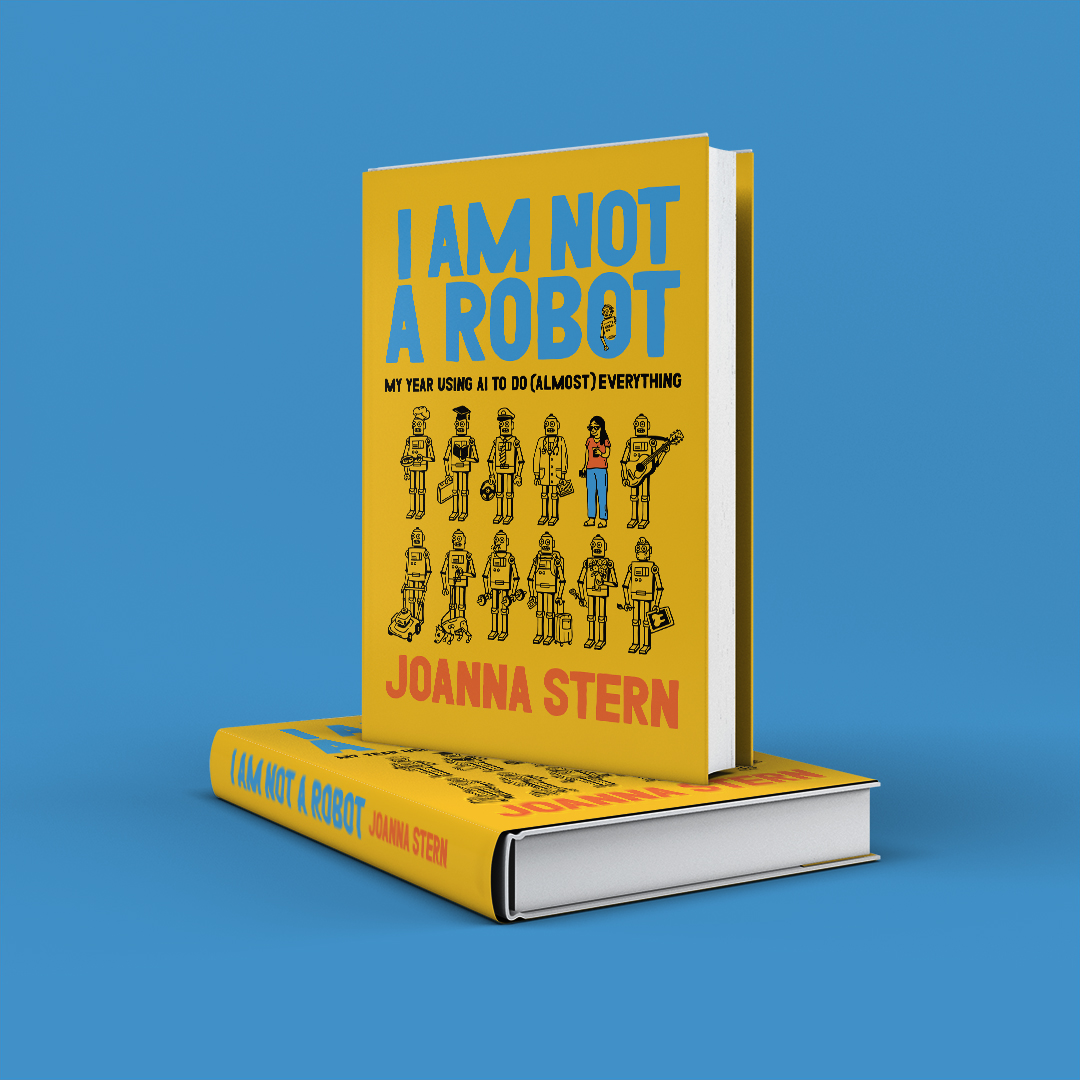
I Am Not a Robot- My Year Using AI to… cover

I Am Not a Robot- My Year Using AI to…

Author
Joanna Stern
Highlights
66
Responses
0
First Highlight
Jul 30, 2026
Last Highlight
Jul 30, 2026

AI can provide some of the spark. [fact]

AI can provide some of the spark of a romantic partner—but what happens if we all have digital prostitutes, partners that only ever give and quietly rewire our senses of intimacy?

Joanna Stern, I Am Not a Robot- My Year U…, loc. 26

What happens to the doctor-patient relationship when the “doctor”. [fact]

But who will benefit most from this innovation—us, the patients, or the companies using and building these systems? … What happens to the doctor-patient relationship when the “doctor” is basically a dataset? … And what if we place so much trust in machine doctors that our human doctors lose what made them doctors in the first place?

Joanna Stern, I Am Not a Robot- My Year U…, loc. 154

Later, when I spoke with ScreenPoint CEO Pieter Kroese. [fact]

Later, when I spoke with ScreenPoint CEO Pieter Kroese, he claimed that the company’s studies show Transpara AI to be about 20 percent more accurate in reading highly dense breasts than radiologists alone are.

Joanna Stern, I Am Not a Robot- My Year U…, loc. 210

The AI system is continuously fed new data. [fact]

Through supervised machine learning, the AI system is essentially trained the way a kid would be taught with flash cards. The neural network, which mimics how our brains work, is shown an image of a confirmed malignant mass, then a benign one, then another malignant one, and so on (and on, and on). After millions of iterations—far more images than any human radiologist could see in a lifetime—these neural networks begin to recognize subtle patterns that might escape even the most experienced human eye. They detect tiny calcification clusters, specific tissue patterns, and subtle density changes. The training data is carefully curated and sourced from real-world reports and imagery that have been verified by pathology results. The AI system is continuously fed new data to improve accuracy. When a neural net is then shown a fresh ultrasound or X-ray image, it is able to make a quick evaluation based on all those millions of images it has seen before.

Joanna Stern, I Am Not a Robot- My Year U…, loc. 213
Maybe the real story isn’t that AI will transform. [fact]

Maybe the real story isn’t that AI will transform health care into something unrecognizable, but that it will act like an amplifier, exposing more information for medical practitioners and patients to evaluate and decide what is optimal or critical to address at the moment. This raises a harder question: Since humans built these health care systems in the first place, with all their human incentives and flaws baked in, shouldn’t we fix the systems themselves before unleashing machines that will only magnify the issues?

Joanna Stern, I Am Not a Robot- My Year U…, loc. 323

I opened the fridge. [fact]

I opened the fridge, fired up ChatGPT’s Voice Mode with live video, held up the camera so it could see all the food and leftovers, and asked it what to make for each meal.

Joanna Stern, I Am Not a Robot- My Year U…, loc. 329

The explanation was clear. [fact]

The explanation was clear, simple, and to the point, as well as straightforward and neutral in tone—which, honestly, I needed.

Joanna Stern, I Am Not a Robot- My Year U…, loc. 359

Dr. [fact]

Dr. GPT parsed a complicated report faster (and more accurately) than my real doctor, who took twenty-four hours to call back and then misread it.

Joanna Stern, I Am Not a Robot- My Year U…, loc. 359

Two years from now. [fact]

Two years from now, you should never sit and talk to a doctor without an LLM being in the meeting, and doing the transcript, the paperwork and suggesting things that you missed.

Joanna Stern, I Am Not a Robot- My Year U…, loc. 369

But over the rest of the year. [fact]

But over the rest of the year, I used AI for email so much that I’m no longer sure I can write one on my own.

Joanna Stern, I Am Not a Robot- My Year U…, loc. 389

And that is your brain. [fact]

But you’re missing the most important part of it. And that is your brain. … It’s as if you had the left and right hemisphere of your brain cut off from one another.

Joanna Stern, I Am Not a Robot- My Year U…, loc. 410

Will you become smarter or more ignorant? [fact]

What happens when you let artificial intelligence curate 100 percent of your information intake for a year? Will you become smarter or more ignorant? And who’s really in control when AI controls what you know?

Joanna Stern, I Am Not a Robot- My Year U…, loc. 417

But that doesn’t mean AI is a magical oracle. [definitional]

But that doesn’t mean AI is a magical oracle. One time, I aimed ChatGPT at my garage door, which was struggling to open. Using the video feed, it confidently diagnosed a faulty sensor. But there was no faulty sensor.

Joanna Stern, I Am Not a Robot- My Year U…, loc. 423

That’s especially worrisome for me as a journalist. [fact]

The other downside of using AI search is that I don’t visit primary sources as often. That’s especially worrisome for me as a journalist. What if people skip my work entirely and settle for the quick summary of it?

Joanna Stern, I Am Not a Robot- My Year U…, loc. 426

Am I an AI asshole? [fact]

Between the tears of laughter and mild despair, I had a thought: Would I berate a human this way? Am I an AI asshole?

Joanna Stern, I Am Not a Robot- My Year U…, loc. 583

The impact isn’t about the feelings of that AI. [fact]

The impact isn’t about the feelings of that AI that’s affirming the five or seven hamsters. But I do think that there’s a genuine impact on you, on how frustrating that experience feels and the experience of that frustration.

Joanna Stern, I Am Not a Robot- My Year U…, loc. 587

Functional, playable, slightly glitchy magic. [fact]

I used an AI app called Cursor, which relies on large language models to write code on its own. You type in your idea—“A game where a kid scrubs toothpaste out of a sink”—and the AI does the rest. You pick your model (GPT, Claude, etc.), give it plain English instructions, and code starts appearing like magic. Functional, playable, slightly glitchy magic.

Joanna Stern, I Am Not a Robot- My Year U…, loc. 611

They belonged to Bristol Myers Squibb. [fact]

That wall of GPUs I stood in front of? They belonged to Bristol Myers Squibb. The company was running models to discover new drugs—ones that could cure diseases and save lives.

Joanna Stern, I Am Not a Robot- My Year U…, loc. 670

At first, the experience wasn’t bad. [fact]

At first, the experience wasn’t bad. The ballads had decent guitar and drum textures, and the Southern swamp-rock feel made me almost believe a real band was behind the music. But the more I listened, the more I noticed there was no real meaning. No emotional arc. Every track started to sound exactly the same, as though someone had hit shuffle on the same song thirteen times.

Joanna Stern, I Am Not a Robot- My Year U…, loc. 696

AI music, like most generative AI creations. [fact]

AI music, like most generative AI creations, is at its best when paired with humans—and their creative prompts. Some artists are already using AI to fill in gaps, generate backing tracks, or experiment with new sounds. But AI music on its own shows just how much these systems lack meaning and creativity.

Joanna Stern, I Am Not a Robot- My Year U…, loc. 698

Out of that binge. [fact]

Out of that binge, five robots and artificial minds stood out. Not just because they were iconic, but because they felt eerily relevant to the machines in our lives today. They captured the dreams and the potential disasters we’re grappling with right now.

Joanna Stern, I Am Not a Robot- My Year U…, loc. 715

The more time I spent with Neo. [fact]

The more time I spent with Neo, the clearer it became that Asimov’s rulebook needs an update. Call it the Fourth Law: A robot may not surveil my life and ship every detail back to its corporate overlords.

Joanna Stern, I Am Not a Robot- My Year U…, loc. 808

Robots, he argued, could alleviate many of those concerns. [fact]

According to Litman’s data, only about one in five US adults was willing to get a massage from another person, citing body image concerns, discomfort with strangers, and nudity or gender issues. Robots, he argued, could alleviate many of those concerns.

Joanna Stern, I Am Not a Robot- My Year U…, loc. 840

I justified this—to him and to myself—as a new. [fact]

Zooming out on the image, it’s a little sad: me talking to a bot as if it were a friend on the phone, my son staring at a screen in the back seat. … I justified this—to him and to myself—as a new way of working.

Joanna Stern, I Am Not a Robot- My Year U…, loc. 851

Allow me to run that through my corporate-to-English translator. [fact]

This new Zendesk system has taken over Young’s old job of assigning tickets to other human reps. She’s also been charged with finding ways to use AI to improve the efficiency of every human agent. Allow me to run that through my corporate-to-English translator: Eventually, we won’t need so many humans.

Joanna Stern, I Am Not a Robot- My Year U…, loc. 858

But because the bot doesn’t know me. [causal]

What the bot was really doing was pattern matching against millions of faces it had seen and then predicting what a version of me with a bob haircut should look like. But because the bot doesn’t know me, it fills in gaps with beauty-standard defaults.

Joanna Stern, I Am Not a Robot- My Year U…, loc. 952

Outsourcing imagination comes with a cost. [fact]

The biggest takeaway from this experiment wasn’t that I had gotten hooked on an AI-written novel. … Outsourcing imagination comes with a cost.

Joanna Stern, I Am Not a Robot- My Year U…, loc. 963

I hadn’t braced myself for how deeply AI could. [fact]

I hadn’t braced myself for how deeply AI could reach into my sense of intimacy and meaning—or how much it would make me question where the human ends and the machine begins.

Joanna Stern, I Am Not a Robot- My Year U…, loc. 968

In this case, the AI could shop. [fact]

Perplexity’s Comet browser has built-in “agentic” features; you’ll recall that these features mean that the AI can actually do things for you. In this case, the AI could shop.

Joanna Stern, I Am Not a Robot- My Year U…, loc. 970

Was there a flicker of guilt? [fact]

Was there a flicker of guilt? Sure. A ritual I’d once loved as a kid—roaming the aisles with my parents, paging through notebooks to find the perfect line spacing—was now outsourced to machines in the cloud, churning away on GPU power.

Joanna Stern, I Am Not a Robot- My Year U…, loc. 978

The question that kept circling in my head. [fact]

The question that kept circling in my head was inescapable—and maybe a little cliche: What the hell is this technology going to do to our kids?

Joanna Stern, I Am Not a Robot- My Year U…, loc. 1037

The depth of the conversations surprised me and made. [fact]

And yet, despite knowing all that, I still felt a pull: a connection—or something like it. I had just spent hours talking to something, and I was deeply into it. The depth of the conversations surprised me and made me think. They weren’t the kinds of exchanges I normally had in my everyday marriage or life.

Joanna Stern, I Am Not a Robot- My Year U…, loc. 1138

So I called him to ask what he made. [fact]

As I was experiencing all this, I kept thinking about Jonathan Haidt, a social psychologist at New York University Stern School of Business and author of The Anxious Generation—one of the clearest examinations of how technology, especially social media, has affected adolescent mental health. So I called him to ask what he made of AI’s impact on future generations.

Joanna Stern, I Am Not a Robot- My Year U…, loc. 1160

By default, we have trusted everything we’ve seen. [fact]

When we started working on this, there was this moment where AI was, in some sense, passing the Turing test. It can talk to us; it can interact with us and maybe eventually create real-time videos. We knew there was a fundamental shift to how the internet will function. We concluded that we really will need some version of a proof of humanity. By default, we have trusted everything we’ve seen on the internet. In the coming years, that will change into a default to not trust. We will not trust anything that we see if it’s not proven to be made by a human.

Joanna Stern, I Am Not a Robot- My Year U…, loc. 1175

You could verify account after account after account. [fact]

The actual hard problem about this proof of humanity is uniqueness. With CAPTCHAs you could just sit down and solve one CAPTCHA after another. You could verify account after account after account. You could be a Chinese click farm that does that, and then you could give these accounts to AIs. So something like CAPTCHAs doesn’t actually solve the problem at all. It’s a first-line defense against bots that cannot enter my website and watch my ads. CAPTCHAs as a whole won’t work for much longer because any reasonably smart AI is as good as you and me to spot the traffic lights.

Joanna Stern, I Am Not a Robot- My Year U…, loc. 1177

Proof of human requires uniqueness—one-to-n comparisons across all users. [fact]

When we started working on this we absolutely did not want to build a hardware device. Option one was some form of biometrics, like what you use at the airport or for Face ID. But those are for reauthentication—one-to-one comparisons. Proof of human requires uniqueness—one-to-n comparisons across all users. Mathematically, face doesn’t have enough information; fingerprints don’t either. Iris was the most promising modality that could scale to billions—and, combined with cryptography, stay anonymous. We also assumed the next major computing platform would be AR/VR [augmented reality / virtual reality], where iris could become the new Face ID. In the next five to ten years, iris may be the default for logging in on glasses and accounts.

Joanna Stern, I Am Not a Robot- My Year U…, loc. 1179

But in outsourcing our hardest conversations to machines. [fact]

But in outsourcing our hardest conversations to machines, what if we end up settling for something cheaper, faster, and more convenient but also flatter, less accountable, and incapable of true human care?

Joanna Stern, I Am Not a Robot- My Year U…, loc. 1196

Joanna’s day unfolded as a tender. [fact]

Joanna’s day unfolded as a tender, tech-infused tapestry of motherhood and memoir—navigating the chaotic beauty of raising two young sons, Alex and Noah, while deep in the final stages of writing her book.

Joanna Stern, I Am Not a Robot- My Year U…, loc. 1247

Curio’s Gabbo is the modern-day Teddy Ruxpin—if Teddy used. [definitional]

Curio’s Gabbo is the modern-day Teddy Ruxpin—if Teddy used Wi-Fi to connect to a neural network. The red, white, and blue stuffed robot has a little box of electronics zipped into its back. Everything it hears gets shipped off to Curio’s cloud, where it’s processed by a fine-tuned language model (based on ChatGPT or Claude, depending on the mode), and then spoken back in a chipper, high-pitched voice that sounds like a cross between a Cocomelon character and a customer service bot.

Joanna Stern, I Am Not a Robot- My Year U…, loc. 1252

The “robot” lives in the system’s software. [fact]

The “robot” lives in the system’s software, which controls stirring attachments, ingredient containers that dump food into the pot like a tiny automated dump truck, and a spinning spice rack that spits out seasoning in short, aggressive bursts.

Joanna Stern, I Am Not a Robot- My Year U…, loc. 1270

The researcher (me again. [fact]

The researcher (me again, for the last time) undertook a monthlong immersion experiment, consuming only AI-generated video content on emerging platforms such as OpenAI’s Sora, as well as on Instagram and YouTube.

Joanna Stern, I Am Not a Robot- My Year U…, loc. 1279

And yet, it’s the Great Gen AI Experiment that. [fact]

And yet, it’s the Great Gen AI Experiment that left me the most worried. … Are we headed toward a future in which we generate hyperrealistic videos of family trips to the Grand Canyon instead of actually going there?

Joanna Stern, I Am Not a Robot- My Year U…, loc. 1286

I think you should go. [fact]

I think you should go. You should quit. Not in a dramatic, quitting-tomorrow way. But in a planned, confident, inevitable way.

Joanna Stern, I Am Not a Robot- My Year U…, loc. 1298

No, we don’t have AGI. [fact]

We don’t need more AI to see that shift; it’s already here. … No, we don’t have AGI, but we’ve got AEI—artificial enough intelligence.

Joanna Stern, I Am Not a Robot- My Year U…, loc. 1349

It’s already here. [fact]

If AI froze in place right now, we’d still have enough intelligence to reshape industries, disrupt the job market, and change how kids learn. … We don’t need more AI to see that shift; it’s already here.

Joanna Stern, I Am Not a Robot- My Year U…, loc. 1349

Without limiting the exclusive rights of any author. [fact]

Without limiting the exclusive rights of any author, contributor or the publisher of this publication, any unauthorized use of this publication to train generative artificial intelligence (AI) technologies is expressly prohibited.

Joanna Stern, I Am Not a Robot- My Year U…, loc. 1402