Jamal Awil

← all books
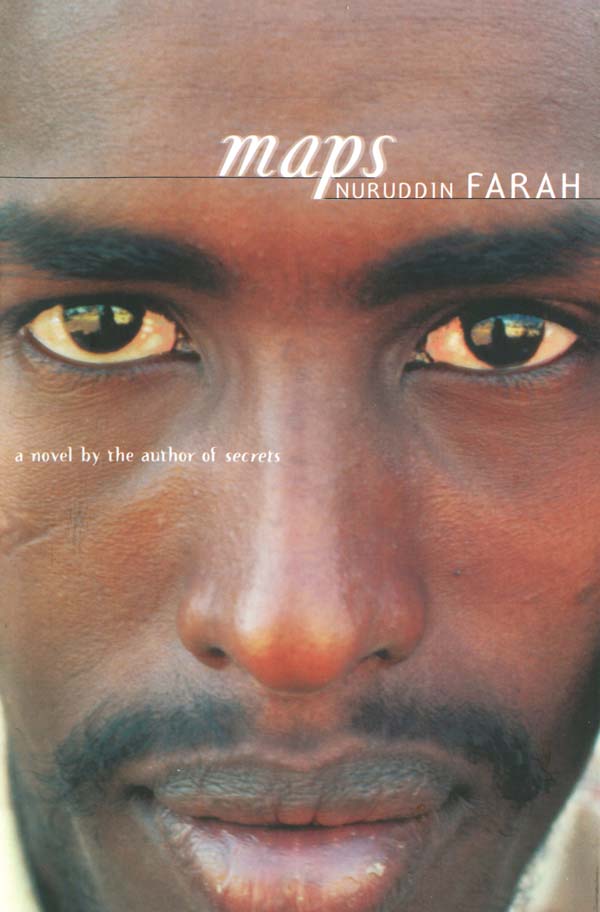
Maps cover

Maps

Author
Nuruddin Farah
Highlights
25
Responses
0
First Highlight
Aug 5, 2026
Last Highlight
Aug 5, 2026

And you question, you challenge every thought which crosses. [fact]

Out of the same past emerges a man wrapped in a mantle with unpatched holes, each hole large as a window—and each window large as the secret to which you cling as though it were the only soul you possessed. And you question, you challenge every thought which crosses your mind.

Nuruddin Farah, Maps, loc. 2809

You didn’t kill your mother. [fact]

As a child, curious as the questions he puts to the adults, I asked Misra if a dead woman, that is my mother, could've given birth to a living thing like me. “You were born early in the evening,” Misra said, “sharing a moment’s life with a falling star. You were cast into darkness, both of you, although the star dropped into extinction while you existed in the dark. No. You didn’t kill your mother.” She concluded her remarks and again held me closer to herself. “Besides, your mother breast-fed you and that, for me, is the reason why you wouldn’t take to other women’s milk, wet-nurses who offered to help. Your mother, how could she breast-feed you unless she survived giving birth to you—tell me, how?”

Nuruddin Farah, Maps, loc. 52353

Does that mean that everybody expresses himself or herself. [fact]

t feels like yesterday, the day I was born; and it feels as if I were there, as though I were my own midwife. Misra’s recounting of what I was like, what I did, coupled with what she was like, what she was doing—these encase me like a womb and I try unsuccessfully to break loose. It is hard to accept or reject when you are told things about yourself as a child. You haven’t the authority to refute them, nor are you easily convinced. Besides, no two persons would agree as to what you looked like or what you did. Does that mean that everybody expresses himself or herself uniquely? Or that everyone is unique and nothing can be expressed correctly?

Nuruddin Farah, Maps, loc. 53717

I think that the patterns of his shoes appealed. [fact]

I think that the patterns of his shoes appealed to my sense of the aesthetic, since their designs reminded me of some of the calligraphic images I had seen painted on doors to the palaces my dreams had taken me to but which I had never entered.

Nuruddin Farah, Maps, loc. 69598

It appeared as though a fountain had. [fact]

It appeared as though a fountain had, just at that instant, right in front of him, right in his presence, given birth to an aqueous marvel of a stream in which fishes of all sizes and descriptions chased one another without any sense of inhibition or forbearance.

Nuruddin Farah, Maps, loc. 100804

Misra convalesced for about a week. [fact]

Misra convalesced for about a week. She was weak. What a kind woman Karin was, he used to think, ploughing the space between a husband who lay on his back from before Askar was born, and Misra whose wounds were fresh and whose memory of the pain therefore most acute. Playful, although he was now old enough to run faster than her, Askar rode on her back as she went back and forth, ecstatic at having found a person as patient, kind and generous as she.

Nuruddin Farah, Maps, loc. 120503

It was she from whom he learnt how. [fact]

It was she from whom he learnt how to locate and name things and people, she who helped him place himself at the centre of a world—her own!

Nuruddin Farah, Maps, loc. 125846

Then the mirror vanished from right in front. [connection]

You felt there was something unfinished about you, as though you had made yourself in such haste you roughened your features unnecessarily You had the feeling, however, that your face fitted you extraordinarily And the identity ofyour newer self? It was like a dot in the distance which assumed features you could identify, becoming now a man, now a woman—or even an animal, your perceptions of the new self altering with the distance or nearness of the spot of consciousness. Then the mirror vanished from right in front of you and the wall which had been there replaced it. And there on the wall appeared shadows and the shadows were speaking with one another, some laughing, some listening and some holding hands or touching one another.

Nuruddin Farah, Maps, loc. 141720

My back” he said. [fact]

One morning, he didn’t get up to say his *subx-*prayers. “My back” he said. And from that moment on, he lay on his back, on a mattress on the floor. His wife washed him once daily—no, washed is not the right word. What she did was to wet a cloth a little bigger than a face towel in soapy water and run it all over his body, rubbing harder where it was hairier. For ablutionary purposes, it was he who performed it, whispering the right traditions and verses as she dipped the cloth in cleaner water, massaging the proper places himself. He prayed, lying on his back. He didn’t go through the body-motions of sujuuds and rukuucs. To the suggestion that they consult a doctor, cost what it might, his response had been, “I have no more jobs to do.

Nuruddin Farah, Maps, loc. 171216

What mattered, he told himself. [fact]

What mattered, he told himself, was that now he was at last a man, that he was totally detached from his mother-figure Misra, and weaned. In the process of looking for a substitute, he had found another—Somalia, his mother country It was as though something which began with the pain of a rite had ended in the joy of a greater self-discovery, one in which he held on to the milky breast of a common mother that belonged to him as much as anyone else. A generous mother, a many-breasted mother, a many-nippled mother, a mother who gave plenty of herself and demanded loyalty of one, loyalty to an ideal, allegiance to an idea, the notion of a nationhood—no more, and no less. And his tormented spirit was calmed the instant he walked down the same steps as everyone else, to encounter this common mother, to be embraced by her in joyful reunion, to be breast-fed and helped to rediscover in himself the need for a mother of a general kind.

Nuruddin Farah, Maps, loc. 226480

Then she said: “How do you mean? [fact]

She stood aside, letting an anxious man pass who was bidding another farewell. Then she said: “How do you mean?”

“It is as if I have no inside,” you said to Karin. “I can feel my rib-cage with my fingers, or knock my knuckles against it, and it drums emptily, as if there is nothing inside, nothing whatsoever; it feels as though I have no heart which beats, no lungs which breathe and no head which can think lucidly.”

She was a dear! She said: “Nonsense.”

Nuruddin Farah, Maps, loc. 279781

Then the man smiled. [fact]

The man took his time. Years later, you would remember his posture as one resembling that of a person from other war-torn areas of conflict, a man residing in the spacious pause of a peace truce in Lebanon or a Ugandan enjoying the quiet following army looting. The man responded: “I am journeying away from graves.”

A number of heads nodded approvingly.

The man continued: “I am travelling, leaving behind me unburied corpses. The tombs are, you might say, those of history. That is to say, these are corpses that should be buried in the tomb of history but that are not; corpses that, at any rate, will be undug every century or so. Somalis come, “Ethiopians” go, every twenty, fifty or a hundred years or so. Waves of atmospheric spirits fill the air of any place where the dead are not buried, ghosts, ferocious as hounds, hunt together, in groups, in the dark and they frighten the inhabitants — it ill-behoves a displaced soul to search for a body in which to take residence,’ Somebody commented: “I dare say!”’ Another asked: “Whose are the unburied corpses?” Then the man smiled. He said: “Our memories, our collective or if you like, our individual pasts. We leave our bodies in order that we may travel light — we are hope personified. After all, we are the dream of a nation.”

Nuruddin Farah, Maps, loc. 283399
Standing against the morning wall of sunshine. [fact]

Standing against the morning wall of sunshine, two oblong lines of light, each solid as a hem and clearly visible as the border of a dress. And there were two horses — one of them black, the other white; the black horse led the way, the other followed him immediately after, like white smoke after black before the red flames pursue each other into invisibility.

Nuruddin Farah, Maps, loc. 298432

I repeated, in disbelief. [fact]

“The tongue I’m speaking with isn’t mine either,’ she said.

1 inquired if there was anything she could claim as her own?

“At times,” she said, “all I own, the only thing that I can hold on to for as long as I want, the one and only thing no one has come for so far, is, would you believe it, a shadow?” and she smiled.

“A shadow?” I repeated, in disbelief.

She nodded.

Nuruddin Farah, Maps, loc. 300376

Every image floats vaguely in a sea of doubt. [fact]

All is illusion — the words written, the mind at which they are
aimed, the truth they are intended to express, the hands that will
hold the paper, the eyes that will glance at the lines. Every image
floats vaguely in a sea of doubt — and the doubt itself is lost in an
unexplored universe of uncertitude.

Joseph Conrad

Nuruddin Farah, Maps, loc. 305264

Which was just as well. [fact]

You did. You began from the beginning, a second time and a third time. Misra was the heroine of your tale now and you played only a minor supporting role. Which was just as well. You needed to tell “Misra’s story”, obviously. A story has to be about someone else even if it is about the one telling it. You talked about your worries, about your inhibitions with regard to other people who mistrusted Misra.

Nuruddin Farah, Maps, loc. 321562

And he sat there, friendly, lovable—and fat. [fact]

And he sat there, friendly, lovable—and fat. I thought that he was two balls screwed together: the top, his head, was round like a globe and it turned on its axis and travelled, returning every time it made a circle, to the point of reference upon which he pontificated; the middle, his chest, was the seat of his emotion—his paunch breathed like bellows when he laughed and his voice had a fiery fervour about it, setting ablaze, inside my head, a great many fires whose thought-flames burned the ground separating me from him.

Nuruddin Farah, Maps, loc. 390197

Could Misra hide in you? [fact]

He put more and more questions to the woman-patient until it became obvious another was speaking through her; another, with a different name and address; another, whose voice interfered with the proceedings, for it emanated from a different other. Could a good person live in an utterly bad one? you ask yourself, your imagination overwhelmed by the thought that this was possible. Could Misra hide in you? Could another dwell in her?

Nuruddin Farah, Maps, loc. 464224

I was eating, with great relish. [fact]

I was eating, with great relish, a slice of the sky and it was most delicious. It was blue—as steaks are brown when well done—and it lay in great heaps in front of me, with a star crowning it as though it were some sort of icing, a star already partly eaten.

Nuruddin Farah, Maps, loc. 481203

To them, the world does not exist. [contrarian]

The blood warms up, his thing rises, he loses his head, his concentration on any other aspect of life is nil. Watch him sneak into bed with her, spy on him courting her, listen to him tell lies to the woman, his victim—what have we here? A body that rules the mind—I almost said, the man. Religion forbids that we subordinate the ‘thinking’ faculties to that of lust. Why? Because, when one is making love, one doesn’t think about God, at least I don’t. Take a look at lovers together, look at the way they concentrate on each other’s demands, offering to each other bodies of sacrifice. To them, the world does not exist. God doesn’t. They do.”

Nuruddin Farah, Maps, loc. 509960

In whose will I reside? [fact]

Misra said, “All that one hopes to remain of one is a memory dwelling in someone’s head. In whose will I reside? Those who brought about my death, or yours?”

Nuruddin Farah, Maps, loc. 538955